


Hungary’s proposed tax package for 2027 also includes changes to the taxation of company cars. The proposal may result in additional costs for businesses in two areas:
- new tax bands would be introduced for higher-performance cars,
- while motor vehicle tax could only be deducted from the company car tax payable on one selected passenger car.
The changes may have a particularly significant impact on companies that operate several passenger cars or use higher-performance models as executive or sales vehicles.
It is important to note that the proposed legislation has not yet been adopted. The amendments are included in Bill T/927, submitted on 27 October 2026, and the details may therefore still change during the parliamentary procedure. The proposed effective date is 1 January 2027.
Motor vehicle tax could be deducted for only one car
Under the current Hungarian rules, motor vehicle tax paid by the applicable deadline may be deducted, on a vehicle-by-vehicle basis, from the company car tax payable on the same car, provided that the statutory conditions are met.
The proposal submitted for 2027 would significantly restrict this option. Each quarter, a business would only be entitled to deduct motor vehicle tax in respect of one passenger car selected by the business.
This means that a company operating several cars would be required to pay the full amount of company car tax on its second and any additional passenger cars, even though it also pays motor vehicle tax on those vehicles.
The change may therefore affect more than just companies with large vehicle fleets. The annual tax burden could also increase for smaller businesses using only two or three passenger cars.
The selection would apply to the entire quarter
The company would be required to indicate in its quarterly company car tax return the passenger car for which it wishes to take the motor vehicle tax paid into account.
The deduction would remain subject to the following conditions:
- both the motor vehicle tax and company car tax liabilities must apply to the same period;
- the person liable for the two taxes must be the same;
- the motor vehicle tax must be paid by the applicable deadline;
- the company must correctly identify the selected car in its quarterly tax return.
Late payment of motor vehicle tax could therefore result not only in a late payment penalty, but also in the loss of the right to deduct the motor vehicle tax from the company car tax.
New tax bands to be introduced above 120 kW
The amount of company car tax currently depends on the vehicle’s engine power expressed in kilowatts and its environmental classification code.
The submitted bill would further divide the category above 120 kW. Under the new system, the following performance bands would be introduced:
- between 121 and 140 kW;
- between 141 and 180 kW;
- between 181 and 250 kW;
- above 250 kW.
The higher the vehicle’s performance and the less favourable its environmental classification, the higher the monthly tax payable would be.
How much could the monthly company car tax be next year?
| Vehicle performance | Environmental classification codes “0–4” | Environmental classification codes “6–10” | Classification codes “5”, “5N”, “5P” and “14–15” |
| 0–50 kW | HUF 39,000 | HUF 20,000 | HUF 17,500 |
| 51–90 kW | HUF 51,500 | HUF 25,500 | HUF 20,000 |
| 91–120 kW | HUF 77,000 | HUF 51,500 | HUF 25,500 |
| 121–140 kW | HUF 116,000 | HUF 87,500 | HUF 58,500 |
| 141–180 kW | HUF 131,500 | HUF 99,000 | HUF 66,500 |
| 181–250 kW | HUF 172,000 | HUF 129,000 | HUF 86,500 |
| 250 kW felett | HUF 204,500 | HUF 154,000 | HUF 103,000 |
For cars with a performance of up to 120 kW, the table follows the amounts already published by the Hungarian National Tax and Customs Administration for 2027, adjusted in line with the statutory indexation rules. The significant change would affect passenger cars above 120 kW, for which performance-based tax bands would replace the current single category.
The annual tax on a high-performance car could amount to several million forints
Under the proposal, the highest monthly company car tax would be HUF 204,500. Assuming a continuous tax liability throughout the year, this would amount to HUF 2,454,000 per year for a single car.
Within the same performance band above 250 kW:
- the annual company car tax would be HUF 1,848,000 in environmental categories “6–10”;
- the annual company car tax would be HUF 1,236,000 in the more favourable categories “5”, “5N”, “5P” and “14–15”, before any possible deduction of motor vehicle tax.
The transitional exemption for plug-in hybrids will also expire
When planning company car costs for 2027, businesses should also take into account vehicles with the environmental classification codes “5P” and “5N”.
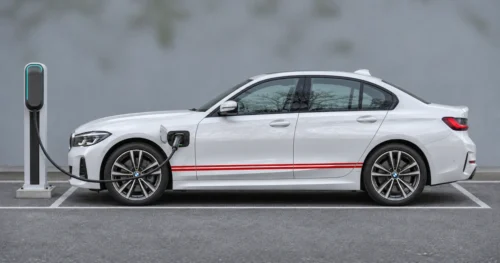
The “5P” code generally covers externally chargeable plug-in hybrid vehicles, while “5N” refers to extended-range hybrid electric vehicles.
As a general rule, these vehicles have already been subject to company car tax since 1 January 2025. However, a transitional exemption applies until 31 December 2026 to “5P” and “5N” vehicles that were first placed into service or entered in the official vehicle register before 1 January 2025. Once this exemption expires, company car tax may also become payable from 2027 on vehicles that were previously exempt.
At the same time, the new table would place “5P” and “5N” vehicles in the environmental category subject to the more favourable tax rates. This would reduce, but not eliminate, the additional cost arising from 2027.
Fully electric and zero-emission vehicles with the environmental classification codes “5E” and “5Z” would continue to qualify as environmentally friendly vehicles. Based on the current rules, no company car tax liability would therefore arise in respect of these vehicles.
Companies should review more than just the cars they own
For company car tax purposes, it is not sufficient to consider only the vehicles owned by the company.
A company car tax liability may also arise in connection with:
- passenger cars acquired under a finance lease;
- cars used under a long-term rental arrangement, depending on the terms of the agreement and the accounting treatment of the related costs;
- privately owned cars where the company claims itemised costs or depreciation in connection with the vehicle;
- passenger cars with foreign registration plates, provided that the statutory conditions are met.
Payment of company car tax in Hungary
In Hungary, as a general rule, company car tax must be assessed and declared quarterly under the self-assessment system. The tax must be reported and paid by the 20th day of the month following the relevant quarter.